

 Dr Rita Parmawati, a lecturer from the Faculty of Agriculture of Brawijaya University has developed an organic mulch tape made from banana waste, water hyacinth, and paitan leaves (Crotalaria sp). The mulch tape can prevent weed growth and reduce soil surface evaporation rate.
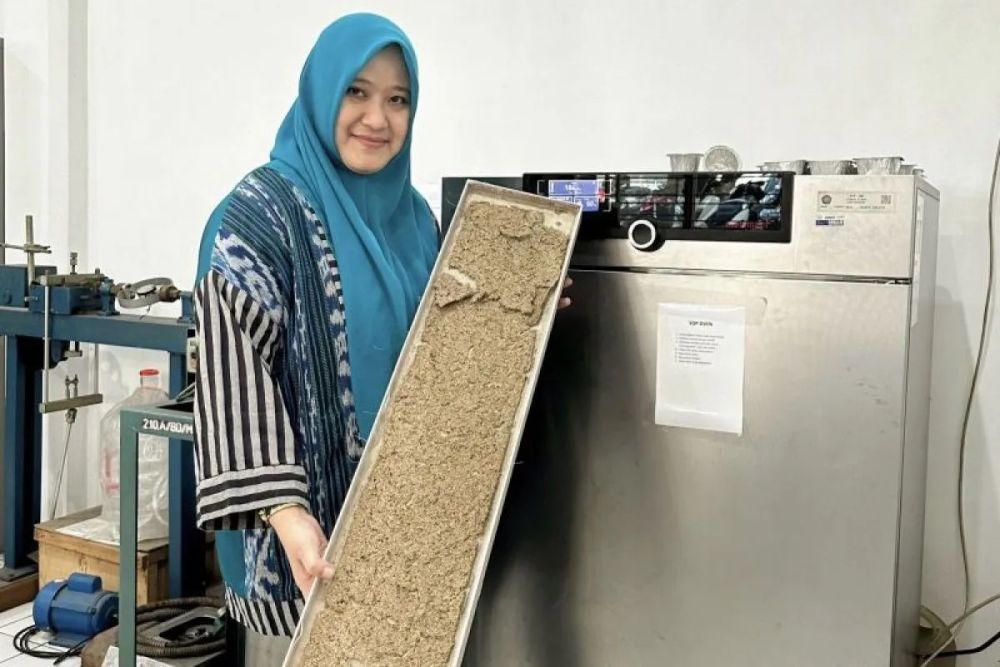
“Organic mulch tape is a technology that replaces plastic mulch, which is considered environmentally unfriendly because it cannot decompose properly. The disadvantages of using plastic mulch are reduced plant growth and yields, increased pest attacks, greater microplastic contamination, waterlogging, loss of soil structure, and reduced activity of soil microorganisms,” explained Dr Parmawati.
According to the lecturer, the new technology will be applied when the second planting season approaches in Malaka District, East Nusa Tenggara (NTT), which has abundant banana waste. “We utilize this banana waste together with water hyacinth and paitan leaves to be crushed, chopped, and moulded into a 25-centimetre-wide sheet,” she said.
She explained that mulch tape suppresses weed growth and reduces surface evaporation by up to 40 percent. When exposed to the sun, the organic mulch tape decomposes into fertilizer.
The process of applying the mulch tape is currently being carried out on a laboratory scale. It is at the socialization stage with the Regent of Malaka Regency, several farmer groups, and heads of departments in Malaka District.
Malaka District was chosen to apply the organic mulch tape technology because, according to Statistics Indonesia (BPS) data, it has low agricultural growth. Rice productivity in the area decreased from 2020 to 2022 due to issues in the supply of rice seeds and other problems involving weeds, evaporation, soil temperature, and irrigation systems.
“We will go to Malaka at the end of July. To make mulch tape for 10 hectares of land, we are working with the PT Widjaya Teknik Indonesia (Witech) factory,” she explained.
To ensure the technology’s sustainability, the local community will be helped in making organic mulch tape, starting with the introduction of materials, chopping, making tape pulp, drying, and pressing.
For more information, please click: https://ub.ac.id
Brawijaya University: https://prasetya.ub.ac.id
Editor: Azis Kurmala, Copyright (c) ANTARA 2024
